
The OGs of Remote Work
In 1969, ARPANET was created by the US Department of Defence. This was the first packet switched network to use TCP/IP. This network was used to connect computers, first across the USA and then in 1973 to the rest of the world. These scientists were the first people who embraced remote working. Remote Working was for the benefit of mankind, a noble endeavour. In 2022, the energetic grandchild of ARPANET has a version of Remote Working, and it has gotten a bad rap. Over the past few years it became synonymous with wearing trackpants on a Zoom call. Mindless scrolling through a news feed with your camera off while you listen to updates from your boss. Workers seen as lazy for wanting the flexibility to work from a location other than an office.
Today, business leaders call for a return to the office citing that it’s better for you the employee. It’s better for your mental health. You’ll be able to meet your team face-to-face, you can have in-person meetings, you can spend 2 hours talking about your dog with a work colleague.
But I’ve got an unpopular opinion: office interaction isn’t needed
It’s not necessary to meet even a few days of the week for a team to be productive. It’s an excuse for poor management and poor guidance and outdated working practices. I’ll introduce you to the OGs of Remote Work.
Before I continue, a bit more history. After the Remote Working pioneers of the 1970s created The Internet, came the Black Hat Hackers and the curious, skilled, and often malicious underground of the internet. And these people very rarely, if ever, set foot in an office to brainstorm attacks on a telco or a bank. They didn’t get together for 5 hours in a meeting room to hash out how to hack into a government organisation. They worked remotely, as a team. They knew each other’s strengths. And they all had a clear picture in their minds of what success looks like.
But, ultimately, these Hackers can’t be the OGs of Remote Work either. True, they were all remote and used online tools to collaborate (message boards, IRC). There are 2 problems with this:
- Much of their “work” was illegal and,
- They were usually independent of their teammates.
For example Kevin Mitnick - the first Hacker that became mainstream. He conducted most of his exploits alone.
Enduring a 5 hour meeting together is a shared experience as much as collaborating remotely on a new sales deck is
For Remote Working to function at a high level, there has to be a shared understanding of the goals the team is working towards. Whether it is a Project goal, Feature goal or target — everyone in the team has to be clear on what success looks like for the team. Each team member should have implicit trust in their other team members to do their job as best they can. If they fail at their job then they communicate as soon as they fail. The feedback loop should be tight. They should trust in their team mates so much that they forget what their teammate is going to do. There needs to be faith within the team that their entire leadership staff know what they’re doing too.
The team doesn’t need to all be in the office once a week to show that they’re still real people behind their online avatars. It’s definitely nice to meet teammates. People like to think this builds morale and team strength. They want to build in-person Shared Experiences. The thing is, playing laser tag together as a team is a shared experience just as much as performing a detailed code review is. Or enduring a 5 hour meeting together is a shared experience as much as collaborating remotely on a new sales deck is. I know that as humans we love interaction with other humans. It’s good for us to do this. But to say that it helps us be a better team is not a good reason to make us all be present in an office. If someone wants human interaction they can go outside and say hello to people in the street. Or volunteer at a children’s hospital or a homeless shelter and talk to people there.
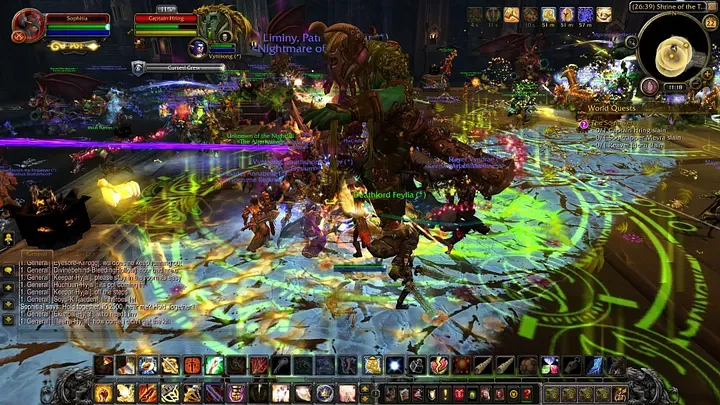
And now, introducing the real OGs of Remote Work
In the 1990s, The Internet exploded and Remote Working started to get serious. The late 90s saw a new genre of distributed activity; online game playing. MMORPGs (Massively Multiplayer Online Role-Playing Games) became popular, with games like EverQuest and Ultima Online. Then came Counter Strike and World of Warcraft. The latter had dedicated players, a thriving community and great teams of players who knew exactly what their mission was. They had a detailed understanding of how they could succeed in their mission. They knew how to work together. They knew that another person in their team had the skills that they were missing.
These people built on the shared knowledge and the shared experiences of playing the game as best they could. Like the Hackers before them, and even the international collection of scientists and academics before them — their bond as a team wasn’t borne from being in an office together, or meeting 3 days a week in person.
The decision to return to an office should be one made by the team. It should be one suitable for the team. There should be no problem if some of the team want to meet every 3 months, the same if some team members feel comfortable going to the office 3 times a week.
From the examples above, there is a common thread. Each of the teams had a shared set of tools that they could use to collaborate with. For the ARPANET scientists, this was an understanding of engineering concepts and standardised ways to read and write computer code. For the Hackers, this was illicit knowledge of phone systems and how to break software. For the World of Warcraft players the application itself is the tool. The full feature set of in-game tools, designed exactly with a specific purpose in mind empowered a person to become the best player they could be.
To understand Remote Working in 2022, it is vital to understand how highly functional teams can exist online. Instead of meeting in person, all they need is clear communication, trust, and a shared understanding of how they can achieve a goal.